 By
By The height of an aerial hammock is not simply a matter of personal preference. It changes how a participant enters a pose, how much body weight the fabric supports and how easily the feet can reach the floor. People attending aerial yoga should therefore treat hammock height as part of the exercise setup, not as an adjustment to make independently.
A correctly selected height can make supported movements easier to understand while allowing the instructor to maintain a consistent class structure. A height that is unsuitable for the participant or exercise may increase uncertainty, alter loading and complicate transitions.
Hammock Height Changes the Starting Position
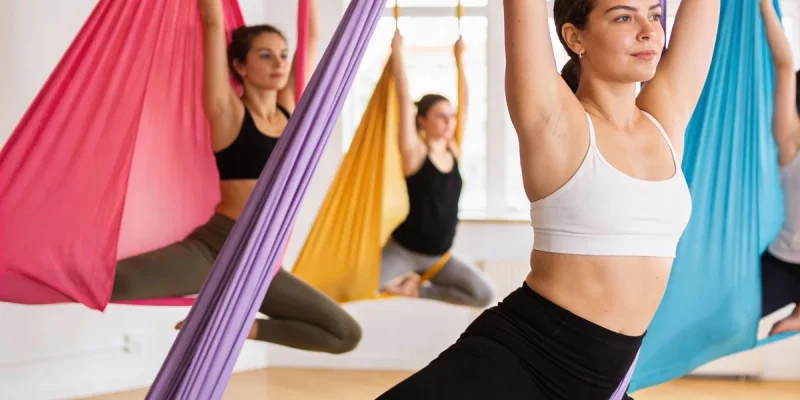
Aerial yoga involves more than performing familiar floor-based poses in suspended fabric. The hammock creates a movable support point, and its height determines the participant’s relationship with the floor.
For standing movements, the hammock may support the hips, thighs, hands or upper body. If it is positioned too high, a shorter participant may struggle to transfer weight into the fabric while keeping the feet grounded. If it is too low, a taller participant may need to bend excessively before the hammock begins providing useful support.
The correct height also depends on the exercise. A setup suitable for a supported squat may not create the same experience during an inversion or a suspended balance. This is why participants should follow the instructor’s setup rather than assuming that one preferred height works for every class.
A Higher Hammock Can Increase Commitment
When the fabric is positioned farther from the floor, entering certain suspended positions may require a more deliberate transfer of weight. Even if the movement is physically manageable, the increased distance from the ground can affect confidence.
Some participants respond by gripping the fabric tightly, holding their breath or rushing through the transition. These reactions can make the body feel less stable. Confidence usually develops more effectively when the participant understands the entry and exit sequence and can perform it without urgency.
A higher setup is not automatically more advanced. Difficulty depends on the pose, the point of contact and the participant’s proportions. In some movements, greater height may create more clearance and make the exercise easier. In others, it may increase the demand of mounting or returning to the floor.
A Lower Hammock Does Not Always Mean a Lighter Exercise
Keeping the hammock closer to the floor may reduce fear because the participant can reach down more easily. However, it can also change the mechanics of the movement.
A low hammock may require deeper bending at the hips or knees before body weight is supported. During certain transitions, the participant may need more upper-body effort because the fabric does not meet the body at the expected point.
The floor can also become an obstacle. If there is insufficient clearance, the hands, feet or head may contact the mat during a movement that requires space beneath the body.
Height should therefore be selected according to the intended exercise, not according to the assumption that lower always means safer or easier.
Fabric Placement Alters Pressure
Hammock height affects where the fabric contacts the body. A small difference in setup may move pressure from the broad area of the pelvis towards the waist, thighs or ribs.
Pressure is not necessarily harmful, but it should remain manageable. Sharp discomfort, numbness or tingling should be reported immediately. Participants should not tolerate intense pressure simply because the exercise looks correct from a distance.
The instructor may respond by changing the body position, adjusting the amount of weight placed into the fabric or selecting a different variation. Sometimes a minor change in angle is more useful than altering the rigging height.
Balance Depends on the Relationship Between Three Points
In many aerial exercises, balance is created between the participant, the hammock and the floor. Each point influences the others.
When both feet remain grounded, the floor provides a stable reference. As one foot lifts, more responsibility shifts to the standing leg and the hammock. When both feet leave the floor, the participant must organise the body around a moving support.
Useful questions during a transition include:
- Can the supporting foot remain steady?
- Is the fabric positioned where the instructor intended?
- Can the participant breathe without excessive gripping?
- Is the movement slow enough to reverse safely?
- Does the participant know how to exit before proceeding?
These checks are more meaningful than trying to hold the most dramatic version of a pose.
Height Also Influences Instructor Access
The instructor needs enough room to observe and assist participants. If hammock heights vary unnecessarily across the room, sightlines become harder to manage and transitions may occur at different levels.
A consistent setup allows instructions to be delivered more clearly. It also reduces the likelihood that neighbouring hammocks move into each other’s working space.
Participants should not alter attachment points, hardware or rigging. These elements belong to the studio’s safety system and should only be handled by trained personnel according to the equipment manufacturer’s guidance and the studio’s procedures.
Building Confidence Without Rushing Progression
Confidence in aerial yoga comes from predictable experiences. Participants are more likely to move calmly when they understand how the fabric will respond and know that they can return to a stable position.
A practical progression may involve:
- Learning to place weight into the hammock while both feet remain grounded.
- Practising controlled entries and exits.
- Reducing hand support gradually.
- Exploring brief periods with one foot lifted.
- Moving into greater suspension only when the earlier steps remain organised.
This progression can be adapted to each exercise. There is no need to advance because another participant is working at a different height or variation.
Preparing for a Singapore Studio Class
Arriving early is particularly helpful for an aerial session. It gives participants time to remove jewellery, confirm clothing requirements and tell the instructor about relevant health considerations.
At Yoga Edition, participants can use the opening setup period to understand why the hammock has been positioned at a particular level. Questions about comfort, previous injuries or uncertainty should be raised before more complex transitions begin.
Anyone with medical conditions that may be affected by inversion, pressure or suspended exercise should seek appropriate professional advice and inform the instructor. Aerial yoga should not be used to test symptoms without guidance.
Hammock height influences load, balance, clearance and confidence at the same time. There is no universally perfect setting. The appropriate height is the one selected for the exercise, the participant and the studio’s safety system. Respecting that setup allows the hammock to function as purposeful support rather than an unpredictable obstacle.